Call Toll Free
1-800-363-6684

Kelowna
1450 KLO Road
Kelowna, BC  V1W 3Z4
(250)469-6187

Vernon
8B - 100 Kalamalka Lake Rd
Vernon, BC  V1T 9G1
(250)558-1170

Penticton
272 Dawson Avenue
Penticton, BC  V2A 3N6
(250)490-3572

Osoyoos
11401-115th Street
Osoyoos, BC  V0H 1V5
(250)495-2555

Spray Lines

Kelowna
763-1946

Winfield
766-2577

Vernon
549-1422

Penticton & Area
487-7516

Osoyoos & Area
495-6518 or 498-3491


Codling Moth Control - Commercial Orchards

All owners of orchard property are responsible for controlling codling moths on their property.  An orchard, as defined by the SIR Program legislation, is a property 0.3 acres in size or greater, with 20 or more planted codling moth host trees (i.e., apple, pear, crabapple, and/or quince).

Identification and Lifecycle

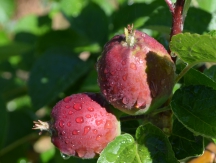
The first step in controlling the codling moth is proper identification, and an understanding of the moth's lifecycle

Sterile Insect Release

SIR Program staff release sterile codling moths into orchards throughout the service area. Staff also install and monitor pheromone traps and provide supplementary fruit inspection.

Sterile insect technology, on which the SIR Program is based, is not a stand-alone control method for orchards.  SIR is part of an integrated pest management regime, and at times it is necessary for growers to apply other standard control measures for codling moths.

Mating Disruption

Mating disruption is another pest management tool available to growers, one that involves the release of synthetic female moth pheromone into the orchard air from plastic tube dispensors. This phreomone release disrupts the normal mating behaviour of moths.

The SIR Program will be utilizing mating disruption in parts of the service area in 2011. More information about the program in 2011 can be seen here.

Like sterile insect release, mating disruption is not a stand-alone control method.


Monitoring

It is important for growers to monitor their own orchards.  Orchardists who spend time in their orchard, who are familiar with areas of their farms that may be susceptible to infestation, and who are being vigilant in their efforts to control the moth, are able to deal with infestation before it becomes a serious problem.

Chemical Control

Chemical controls for codling moths may be necessary in orchards where high wild codling moth concentrations are recorded.  Growers are encouraged to contact their field consultant for advice about the use of chemical pesticides in their specific orchards.  A general overview on the use of pesticides is available here.

Spray records - All growers are reminded to keep accurate and up-to-date records of all pesticide sprays applied to the blocks they manage. You can use the forms developed by the Okanagan Tree Fruit Company (OTFC) in the Integrated Fruit Production Guide or use your own record-keeping form that reports the same information as the OTFC form. If you ship to the OTFC, you must keep spray records in order to ship to the packinghouse as part of the on-farm food safety requirements as prescribed by CanadaGAP. The SIR Program, OTFC fieldmen and private advisors also need these records to uncover possible reasons for failures in codling moth control, and to also determine if growers are eliminating or reducing the number of cover sprays according to codling moth numbers in their blocks.

Organic Control

As with conventional control methods, growers interested in organic codling moth control should contact their organic association and/or their field consultant.  An overview of concepts important to organic codling moth control in orchards can be viewed here.

Remove Sources of Infestation

One easy yet important way that growers can help to reduce the potential for codling moth infestation is to remove host trees that are not, or can not, be properly maintained. Common examples include:

  • host trees planted too close to buildings, fences, and slopes where spray equipment can not access both sides of the trees
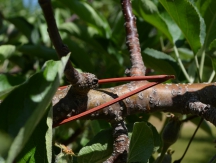
  • wild trees growing in ditches, along fence lines, or from stumps
  • host trees growing in the yards of houses located on orchard properties and crabapple pollinator trees located outside of the main orchard
Firewood

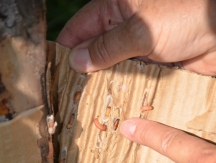
Do not store, or sell, firewood obtained from infested host trees.  Codling moth larvae live part of their life cocooned in the bark and crevices of tree trunks.  Burn, chip, or otherwise dispose of the wood.


home | news | email

Copyright SIR 2012


Did You Know??