Codling Moth Control - Residential Host Trees
All property owners with apple, pear or crabapple trees,
or quince trees or shrubs, are responsible for
controlling the codling moth on their property.
There are several control options available, and
generally a combination of these methods is required.
Infestation can occur right up until late August and
beyond, so it is essential that control methods be
continued until late harvest.
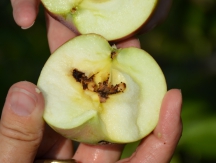
Identification and Lifecycle
The first step in controlling the codling moth is proper
identification, and an
understanding of the moth's
lifecycle.
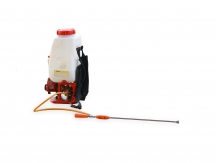
Spraying
There are several chemical pesticides on the market that
provide some level of control of the codling moth.
It is crucial to read the labels of all pesticides and
to follow the directions carefully. Residents who
are uncertain about their ability to properly spray
trees should consider hiring a trained Professional
Pesticide Applicator. Click
here for further information about spraying trees
for codling moth control.
Organic Control
Organic control of the codling moth is one option for
the backyard grower. It is important to
understand, however, that "being organic" does
not mean, "doing nothing."
Organic controls
require significant effort on the part of the tree
owner.
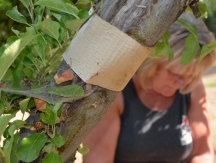
One organic technique that the SIR Program uses
is applying cardboard banding to the trunks of host
trees. To learn more about cardboard banding, read
here.
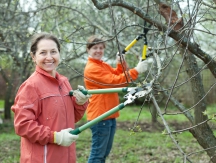
Removal of Blossoms and Fruit
Removing blossoms and fruit from host trees
prior to June 1st is
recommended for homeowners who want to keep trees but
are not interested in the fruit. Prune and open up
the tree canopy during the dormant season (November to
March) then snip off all blossom stems that appear in
early spring. No flowers = no fruit.
Continue to check the trees throughout the season and
remove all missed fruit or new blossoms.
All infested fruit should be sent to the landfill or
placed in a bucket of water for several days to drown
the larvae. Do not
compost infested fruit. Composting fruit allows
moth larvae to continue their
life cycle.
Tree Removal
Host tree owners should carefully consider the costs and
benefits of growing backyard trees. Host trees
that will not get adequate care should be removed.
Wood from host trees that are removed should be burned,
chipped or sent to the landfill. Moths spin
cocoons under the bark and if wood is sold or moved to
another location, the moth moves with it and can infest
a new area.
Firewood
Do not
store firewood obtained from infested host trees.
Codling moth larvae live part of their life cocooned in
the bark and crevices of tree trunks. Burn, chip,
or otherwise dispose of the wood.